
Short-term Earthquake Prediction Based on Seismic Precursory Electric Signals Recorded on Ground Surface.
|
|
“What today seems impossible, is tomorrow’s reality”
Dinos
M 5.0 SOUTHERN GREECE 2025-02-18 16:54:33 UTC
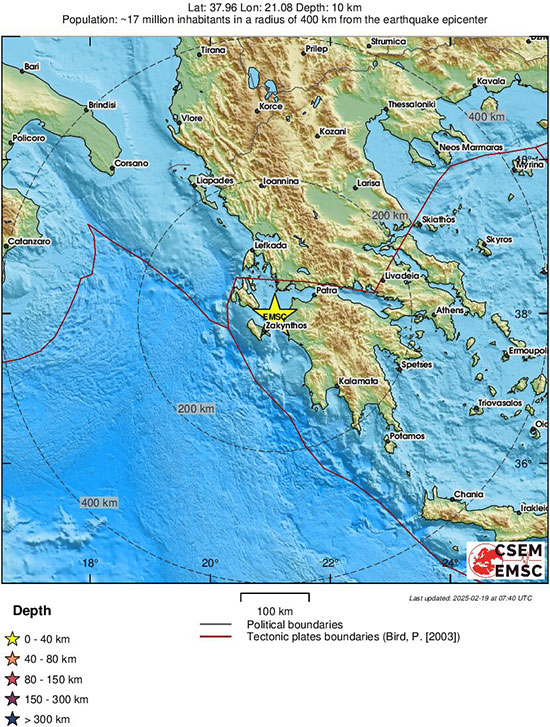
Fig. 1. EQ Location (colored star, after EMSC).

Fig. 2. M1 tidal variation (black line) v.s time of occurrence (red bar) of the EQ.

Fig. 3. Diurnal (K2) tidal variation (black line) v.s time of occurrence (red bar) of the EQ.

Fig. 4. Cummulative Seismic Energy Release (CSER) since 1901 in 1 month sampling interval.

Fig. 5. Expected EQ magnitude due to application of the LSEFM (Lithospheric Seismic Energy Flow Model) on past (since 1911) seismic history of the regional seismogenic area.

Fig. 6. Expected EQ magnitude due to application of the LSEFM (Lithospheric Seismic Energy Flow Model) on past (since 1939) seismic history of the regional seismogenic area.

Fig. 7. Expected EQ magnitude due to application of the LSEFM (Lithospheric Seismic Energy Flow Model) on past (since 1954) seismic history of the regional seismogenic area.

Fig. 8. Expected EQ magnitude due to application of the LSEFM (Lithospheric Seismic Energy Flow Model) on past (since 1967) seismic history of the regional seismogenic area.

Fig. 9. Expected EQ magnitude due to application of the LSEFM (Lithospheric Seismic Energy Flow Model) on past (since 2002) seismic history of the regional seismogenic area.
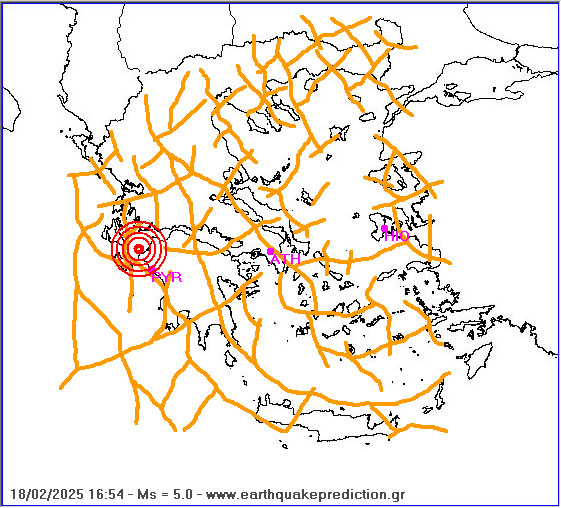
Fig 10. EQ epicenter location (red concentric circles) compared to the deep lithospheric fracture zones - faults (thick brown lines) that have been determined by the processing of the gravity map of the Greek territory (Thanassoulas, 1998).
Contact us at : gthanding@gmail.com